
One panel of doctors. Fifty points of care.
Buying one health ATM is a purchase. Running fifty of them across districts, plants or branches is a programme - and a programme is decided by the things nobody demonstrates: who the doctor on the other end is, where the records land, and who gets the call when a machine in a panchayat building stops printing.
This page is about that shape. Clinics On Cloud call it hub and spoke: connected points of care working as satellite locations linked to doctors or specialists at a central hospital or healthcare facility. Here is what sits at each end of it.

Screening happens where people are. Clinical judgement happens once, centrally.
That is the whole idea, and it is the client's own: telemedicine integrated into the ecosystem, supporting a model in which connected points of care work as satellite locations linked to doctors or specialists at a central hospital.
Health Kiosk
Fixed. One place, all day.
Health Lounge
A room of its own, with somebody in it.
Box Clinic
Carried. Goes to the people.
Mobile Medical Unit
Drives. A new village every morning.
Doctors, dashboards and the record
Teleconsultation from Clinics On Cloud's panel or your own; stakeholder dashboards; digital health records; APIs into HMIS, EMR, LIS, hospital, corporate and government systems.
Four shapes of the same thing, chosen by how the site behaves.
Clinical capability barely differs between them - screening, digital reports, telemedicine and dashboards run on the same software layer. What differs is fabrication and deployment, and that is what should decide the mix.
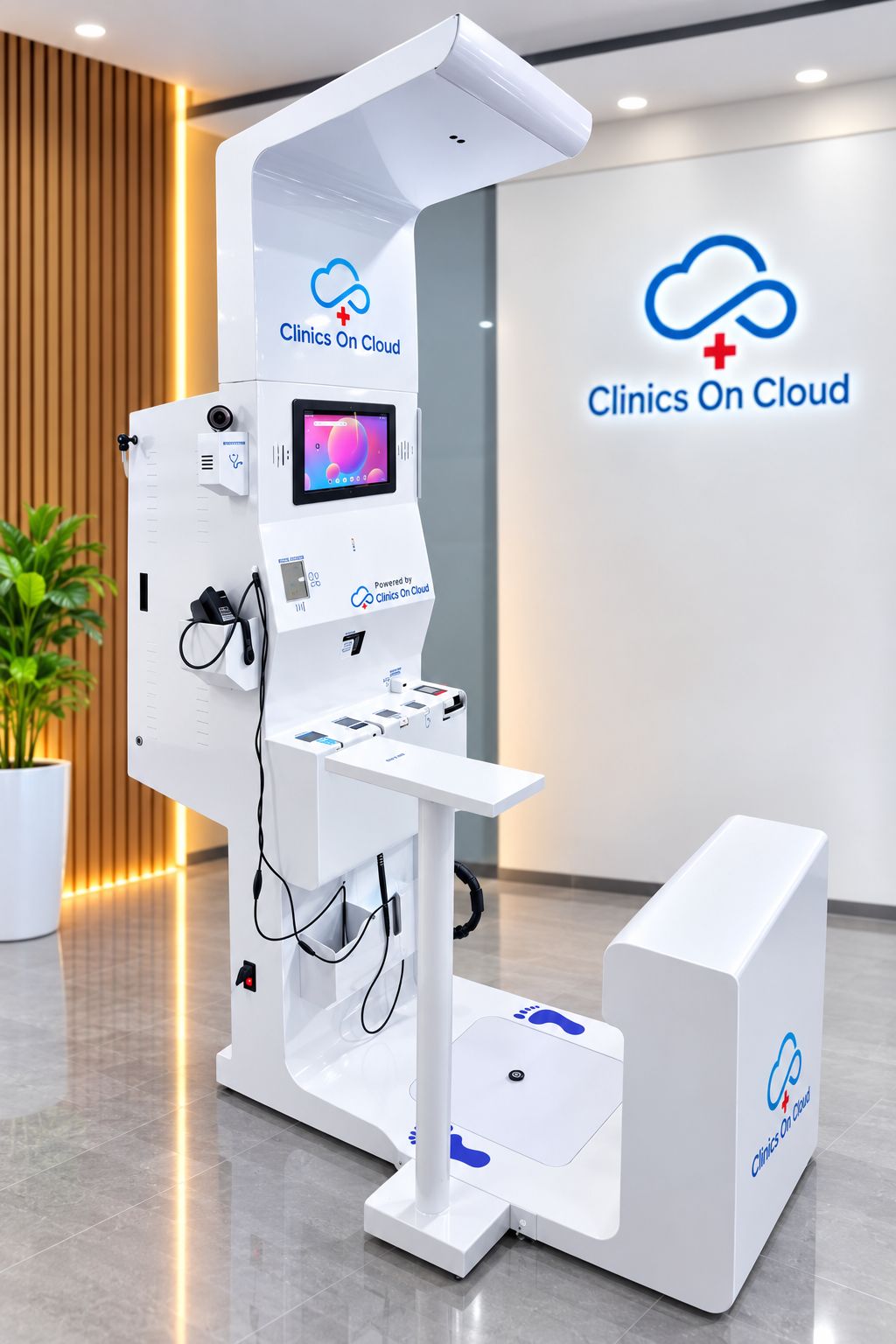
Health Kiosk / Health ATM ₹5-10 lakh
Fixed-format, for one location and continuous use. The indicative range moves with model, parameters, devices, software, telemedicine and quantity.
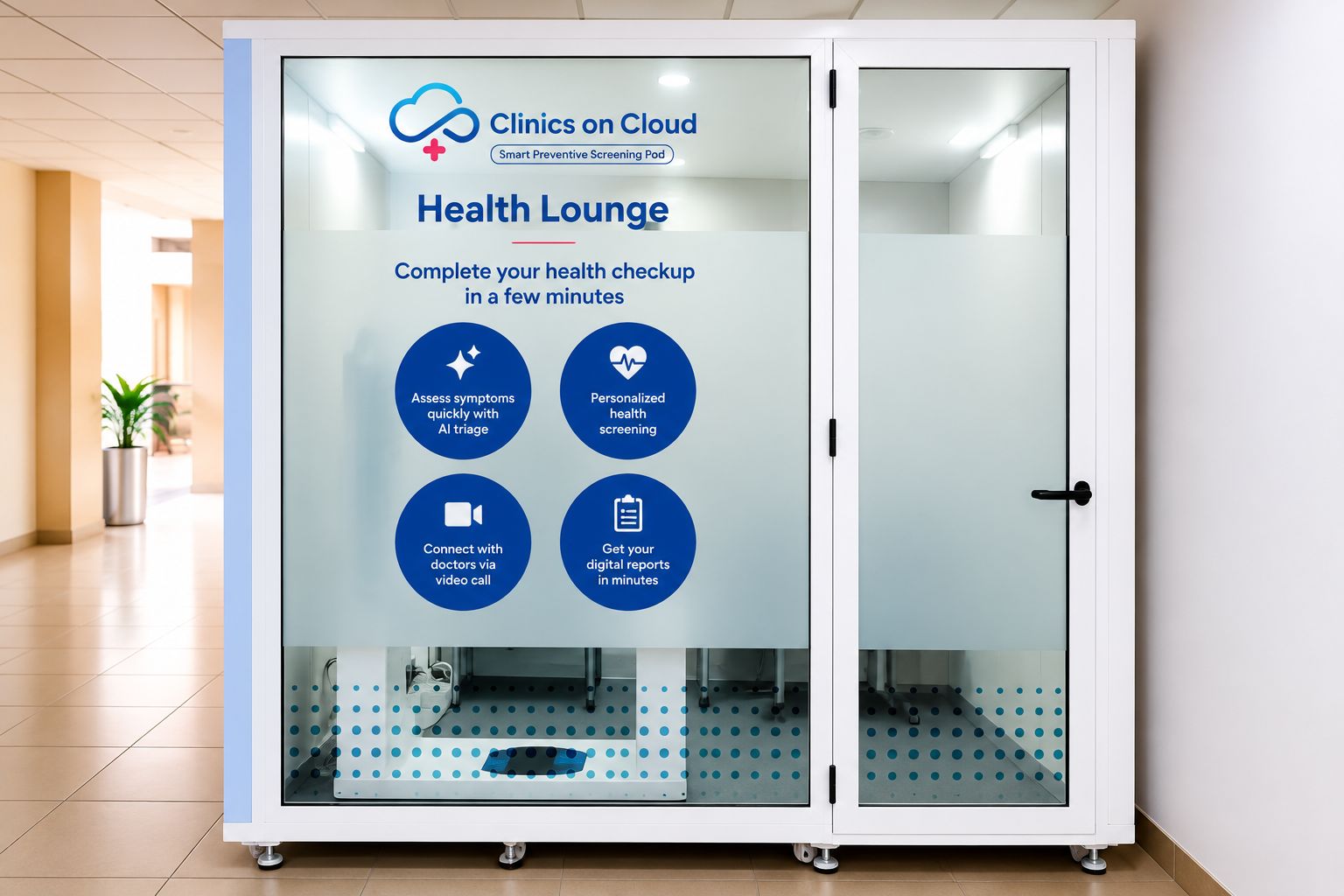
Health Lounge
The kiosk plus the room around it: operator area, consumable storage, AC and connectivity, a private consultation space and a convertible bed for ECG.
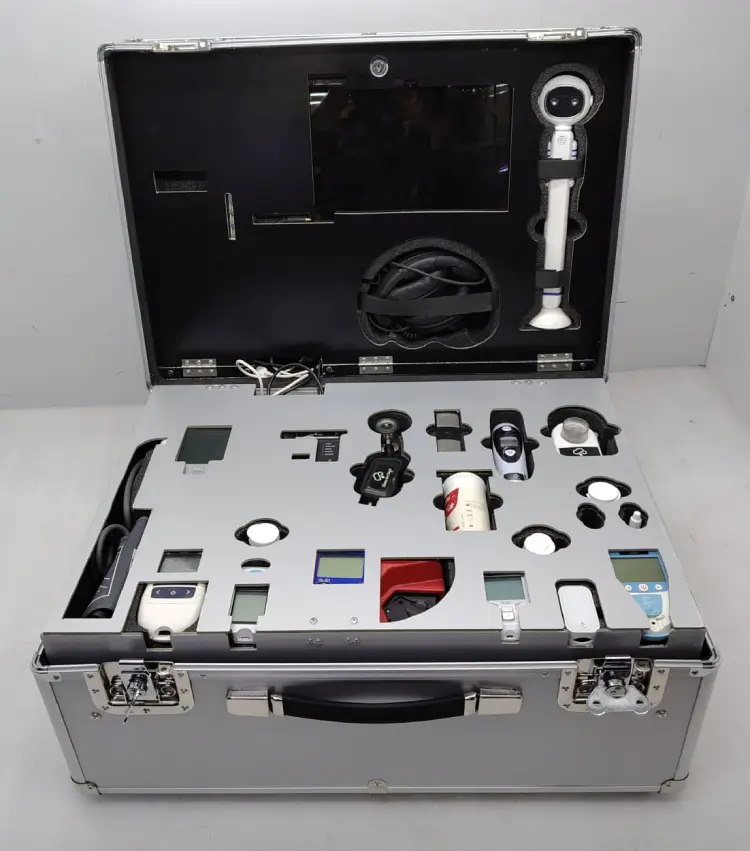
Box Clinic ₹7-9 lakh
Compact and portable: door-to-door, community outreach, offices, schools, pharmacies. Same screening, carried to the person.
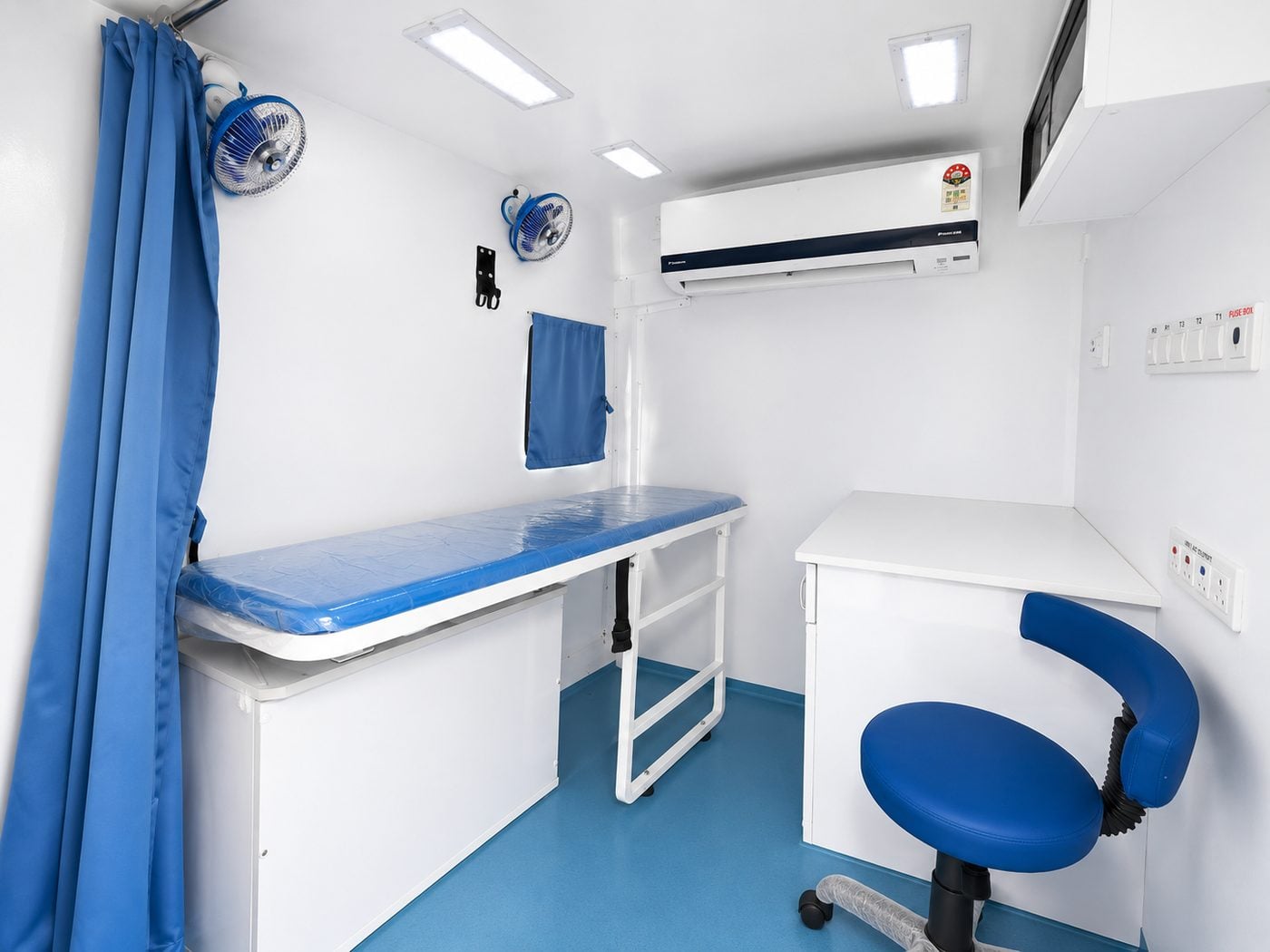
Mobile Medical Unit ₹30 lakh + 18% GST
A branded vehicle with an integrated health ATM, patient bed, air-conditioned cabin and 12-lead ECG, in standard configuration.
Every figure here is the published indicative range, not a quotation. Bulk deployments are priced as a project - quantity changes manufacturing, logistics, installation, support and integration planning, so what you get back is a project proposal rather than a unit price.
What has to exist at the centre before the first spoke goes in.
A network is not fifty machines. It is fifty machines and one place where their output arrives, which is the part that is usually specified last and should be specified first.
Clinics On Cloud's panel, or your own integrated into the platform.
Stakeholder dashboards, so a district or a plant is a number somebody watches.
Digital health records, so a second visit is a trend rather than a new patient.
APIs into HMIS, EMR, LIS, hospital, corporate and government systems.
ABDM and ABHA capability, with the modules confirmed for your deployment version.
AWS with primary, secondary and long-term backups - or your own infrastructure.
The two columns that decide whether year two happens.
Most of what goes wrong in a distributed programme is not technical. It is a job nobody agreed to own, discovered eleven months in. Here is the published split, and the part that is left to you.
“Client-controlled or project-specific hosting architecture can be evaluated… Responsibilities for infrastructure, security, maintenance and compliance should be defined as part of the implementation scope.”
Clinics On Cloud, on hosting patient data yourselfThe order it actually happens in.
Published as the implementation process, with the caveat the client themselves put on it: the exact process varies with the product and the project scope.
-
1
Requirement assessment
Use case, screening parameters, expected quantity, deployment locations - the four answers a quotation needs before it can be accurate.
-
2
Configuration
Parameters, devices, software, branding and integrations, settled per site type rather than per network.
-
3
Manufacturing and QC
Assembly, device integration, software configuration, calibration and quality control at Chakan, Pune, before anything ships.
-
4
Dispatch and installation
Transportation and installation are provided. Timelines follow configuration, quantity, customisation and destination, and are committed with the proposal.
-
5
Software and integration
The hub end: dashboards, records, and whichever of HMIS, EMR, LIS or government systems are in scope. This is scope, not a switch.
-
6
Operator training
Each site's designated operator, on the workflow and on helping first-timers. One trained person is the difference between a used machine and an admired one.
-
7
Support, warranty, AMC
Post-deployment service, with response and resolution terms confirmed for the purchased configuration.
3,500+ deployments, 200+ cities, 8+ countries.
The company's own list of organisations that have deployed its solutions - printed as names rather than as logos, because we hold no permission to use anybody's mark.
International rollouts are planned against each country's medical-device regulations, import requirements, localisation, software integration and service support - which is why a network that crosses a border is a different project from one that does not.
Six things to settle while the pilot is still small.
Each of these is cheap to answer at two sites and expensive at fifty. None of them is a question about the machine.
How is a person identified at every site?
Get this wrong and you have a thousand first visits and no second ones - and therefore no trend, which was the point.
Who answers an abnormal reading, and how fast?
A flag on a report is not a referral. Name the person and name the hours.
What happens when connectivity is out?
Units run offline and sync later, with roughly 4-5 hours of UPS backup. So the real question is how long a site can be dark before anybody notices.
Who reorders consumables, site by site?
If nobody can be named, that site has a shelf life of one box of strips.
Which systems must the data reach?
Integrations belong in the purchase order with the systems named. Retrofitting one costs more than specifying three.
What are the recurring costs per site?
Consumables, connectivity, subscriptions where applicable, telemedicine, biomedical-waste handling and AMC - asked for per site per year, not as a percentage.
Made in India, at a CDSCO-registered and ISO 13485-certified facility


Frequently Asked Questions
Answered by the team at Clinics On Cloud, and kept in step with what they publish - these are pulled from the portal each time this page is built.
What is a Mobile Medical Unit or Healthcare on Wheels?
Mobile Medical Unit (MMU) is a technology-enabled Clinic on Wheels also known as Health On Wheels designed to take healthcare directly to communities where access to hospitals and healthcare facilities may be limited. It can support preventive health screenings, digital health reports, telemedicine from a mobile setup. The Mobile Medical Van can be deployed for rural and remote communities, CSR healthcare programs, government outreach, hospitals, corporates and public health initiatives.
Who can use a Mobile Medical Unit?
Hospitals, corporates, NGOs, CSR organisations, government programs and healthcare providers can deploy Mobile Medical Units for community health, employee health and preventive screening.
What services can a Mobile Medical Unit provide?
A Mobile Medical Unit (MMU) can provide preventive health screening, telemedicine and doctor consultations through an integrated Health ATM. It can also include a patient examination bed and 12-lead ECG facility, enabling more comprehensive on-site assessments. MMUs are especially suitable for health camps, rural healthcare programs, community outreach and large-scale screening initiatives, bringing connected healthcare services closer to underserved populations.
What is the difference between a Mobile Medical Unit and a Health Kiosk?
A Health Kiosk is generally deployed at a fixed location, while a Mobile Medical Unit is designed to travel between locations. An MMU is therefore suited to outreach programs covering multiple communities or sites.
Who can use Mobile Medical Units and where can they be deployed?
A Health Kiosk and Mobile Medical Unit or Healthcare on wheels offer similar healthcare capabilities, including diagnostic and preventive screenings, telemedicine, instant digital reports and stakeholder dashboards. The key difference is the deployment model. A Health Kiosk is primarily designed for continuous use at a fixed location, while an MMU is a fully equipped and branded medical vehicle built for community outreach, health camps and multi-location programs. A kiosk can also be used for camps, but it needs to be transported and set up at each location, whereas an MMU is designed to move directly between communities.
How much does a Mobile Medical Unit cost?
The Clinics on Cloud Mobile Medical Unit (MMU) costs approximately ₹30 lakh + 18% GST. The standard configuration includes the vehicle, integrated Health ATM, hospital/patient bed, air-conditioned cabin, preventive health screening setup, digital health reports and telemedicine capabilities. The final cost may vary depending on the vehicle model, medical equipment, diagnostic capabilities, interior configuration and other customization requirements.
Healthcare is a right. Not a privilege.
We started Clinics on Cloud with a simple belief - that the quality of your healthcare should not depend on your postcode. Whether you’re a government, corporate, NGO or entrepreneur - we built this for you.
+91 8999 073 447
Mon - Sat · 9 AM to 6 PM IST
sales@clinicsoncloud.com
Partnerships · Deployments · Support
www.clinicsoncloud.com
Products · Case Studies · News
Nighoje, Chakan MIDC
Pune, Maharashtra - 410501, India